Return-to-Sport Guide · Atlanta, GA
For active patients — runners, weekend athletes, people who work on their feet — the real question isn't just 'how do I treat this,' it's 'how fast can I get back to normal.' Here's a realistic look at recovery timing.
Firsthand Account
Clinical descriptions only go so far. Here a patient treated for chronic patellar tendinitis describes the experience directly.
TenJet Patient Testimonial - Chronic Patellar Tendinitis (Jumper's Knee)
Video courtesy of HydroCision, Inc., the maker of TenJet®. Individual results vary; this patient's experience is not a guarantee of outcome. Talk with a specialist about whether the procedure is appropriate for you.
The Procedure
The return-to-activity estimates above assume a minimally invasive approach rather than open surgery. That distinction matters: HydroCision, Inc.'s TenJet system is built specifically to avoid the extended downtime that comes with a surgical incision and general anesthesia.
Recovery Timeline
Every recovery is individual, but this general pattern holds for most patients following a minimally invasive tendon procedure.
Rest and activity modification. Most swelling and acute discomfort begins to settle.
Gradual reintroduction of low-impact activity, guided by your physician or physical therapist.
Progressive loading and strength work targeting the tendon.
Return to full sport-specific activity for most patients, pending physician clearance.
See The Procedure
Official demonstration video from HydroCision, the maker of TenJet, plus a look at how tendinitis differs from the deeper tissue degeneration TenJet is designed to treat.
TenJet Patella Tendinosis Minimally Invasive Tenotomy


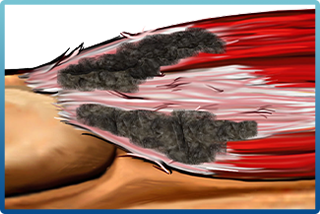
Diagrams and video courtesy of HydroCision, Inc.
Common Questions
Sports medicine physicians and physical medicine and rehabilitation specialists most commonly, sometimes alongside orthopedic surgeons depending on whether surgical options are being considered.
Often. Follow-up ultrasound documents structural change — published cases show a more normal fibrillar pattern and reduced lesion size at twelve weeks.
It is possible but usually staged rather than simultaneous, so that you retain a functional limb during the early protected phase of recovery.
Insufficient symptom duration, an alternative pain source such as joint disease, or findings on imaging that point toward a different intervention. Assessment determines this individually.
This information is general and is not medical advice. Whether any procedure is appropriate for you can only be determined by a physician who has examined you and reviewed your imaging.